Páran Quenya: First Step
Important: I would like to make it very clear that any and all words, phrases, or texts described here are for personal use and carry no intention other than leisure, at the author’s own whim. I take no responsibility for the translation or transcription of text for tattoos or any other third-party purposes.
This will be the first of potentially many articles about Quenya, and I would appreciate it if whoever is reading this page would send me suggestions on how to improve the material or topics you would like to see covered. You are very welcome, and good luck on this journey.
Well, let’s begin. I personally started learning Quenya around 2004, if I remember correctly, through the translation made by Gabriel Brum of the Quenya course created by Helge Fauskanger. There was no other material available in Portuguese at the time, and I had to make do. Today, experience, knowledge of other languages, internet access, and my geographical location lead me to higher levels, and that is why I want to share a bit with anyone who might be interested in the subject.
Naturally, my first step was to search for sources again, and I was surprised by what I found: a wealth of open and public-use material. To simplify things for both of us, I will list the sources below in two different lists: Applied Neo-Quenya; and Primary and Secondary Sources.
My intention now is to follow some of the sources below—possibly a mix of Atanquesta, Tecendil, and Eldamo—while navigating through secondary sources to find something interesting and, perhaps, start a project while I learn Quenya.
Speaking of projects, I could translate and review published materials; some things are clearly outdated, such as the verb table with declensions from Ambar Eldaron. I could also prepare more didactic material. For now, I leave you with this image titled: hröanya / my body.
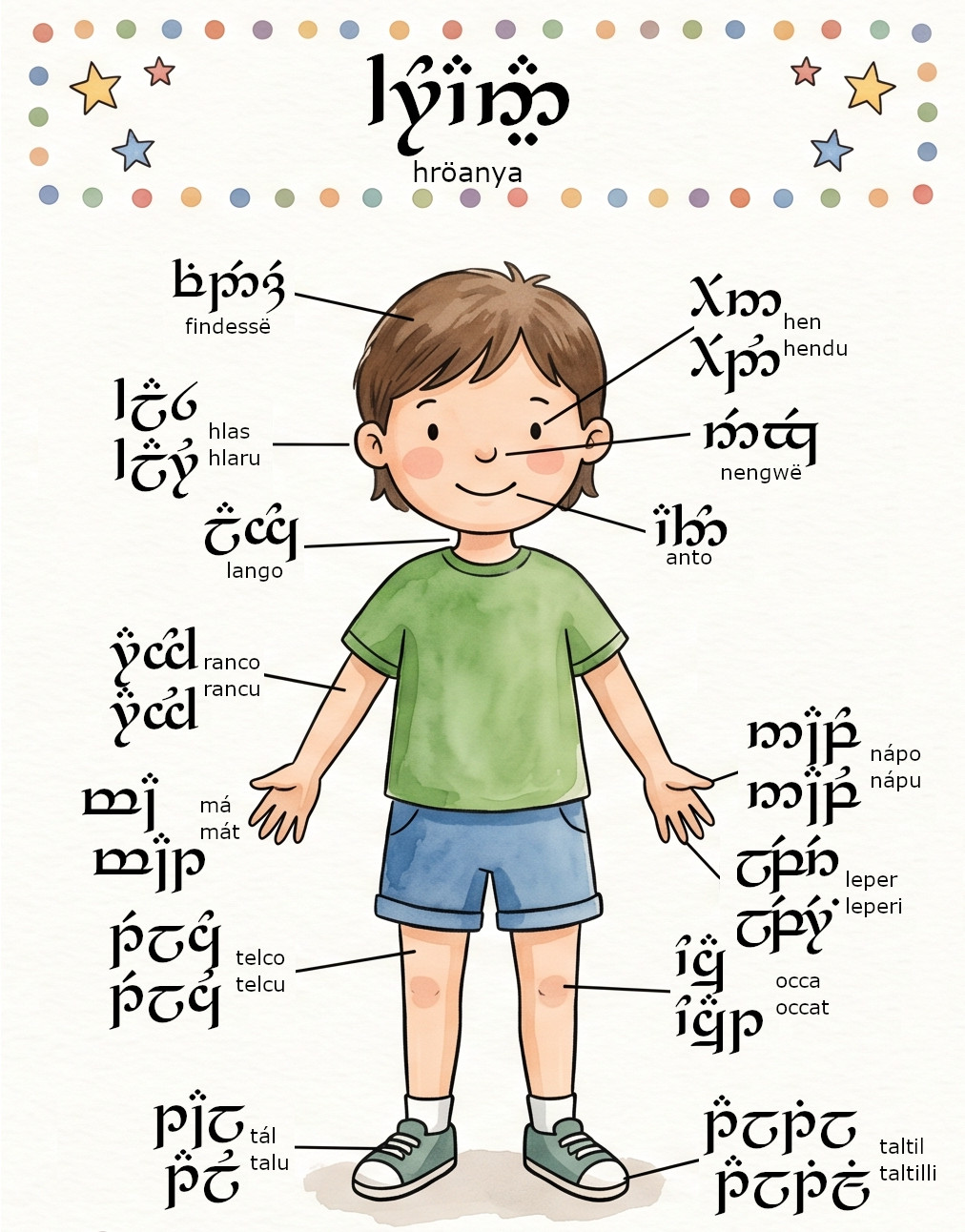
The image was partially AI-generated. The idea, however, was inspired by a 1988 illustration by Tom Loback that served as the cover for the first issue of Vinyar Tengwar. I deliberately reduced the vocabulary presented in that illustration and revised words, spelling and inflections based on the index published on Eldamo.
Grammar references for those who enjoy this kind of detail (aka masochist):
Applied Neo-Quenya and Tertiary Sources #
This refers to: material produced by scholars and enthusiasts based on the study or use of primary and secondary sources.
- Ardalambion.net: By Helge Fauskanger, a site dedicated to Tolkienian languages; it features the aforementioned Quenya course.
- Speak Elf Yourself: Also by Helge Fauskanger, featuring him in the first person teaching Quenya on YouTube.
- Atanquesta: By Tamas Ferencz, this is a Quenya course published in 2018 with the intent of providing a simpler vocabulary focused on everyday life; no kings, towers, or swords.
- Eldamo: By Paul Strack, a lexicon of the languages constructed by the Professor, with an emphasis on Elvish.
- Elvish Composition Archive: An archive organized by Paul Strack, featuring original compositions and translations into Quenya and Sindarin by various authors.
- Vocabulary training cards: By Paul Strack on Memrise, implementing spaced repetition to help with memorization.
- Tecendil: By Arno Gourdol, a converter/transcriber from the Roman alphabet to Tengwar. It also functions as a dictionary with direct integration into Eldamo.
- Ambar Eldaron: A French group offering a Quenya course, as well as verb tables and a book on Elvish botany.
- Mellonath Daeron: The linguistic arm of the Tolkien Society of Sweden (Forodrim), featuring various articles.
- Boktypografen: This page is dedicated to the writing systems derived from Tolkien’s works, created by Måns Björkman Berg, a member of the Swedish Tolkien Society.
- Alcarin Tengwar: An open-source Tengwar font.
- Free Tengwar Font Project: An open-source project providing various Tengwar fonts to the community.
- Tengwar Ariador: Another repository for the open-access font.
- Elfdict: One of the online dictionaries for quick searches of Quenya terms.
- QuenyaTTS: A text-to-speech synthesizer focused on Quenya pronunciation.
- Vinye Lambegormon: A Discord server focused on learning and practicing Elvish languages.
Primary and Secondary Sources #
- Appendices E and F of The Lord of the Rings: Where Tolkien establishes the basics of pronunciation, writing (Tengwar), and the history of the languages.
- The Road Goes Ever On: A song cycle containing linguistic commentary by Tolkien himself, especially regarding the poem Namárië.
- Quettar: Founded by Susan Rule, it was the bulletin of the Linguistic Fellowship of the Tolkien Society (UK).
- The Elvish Linguistic Fellowship (E.L.F.): The E.L.F. is a North American organization dedicated to the scholarly study of J.R.R. Tolkien’s invented languages. Its primary work is published through its two print journals, Vinyar Tengwar and Parma Eldalamberon, as well as its online journal, Tengwestië.
Namárië | See you | Bis geschwënn | Até mais | À bientôt